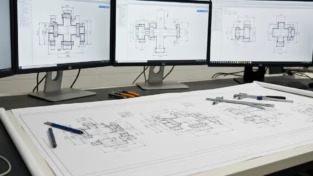
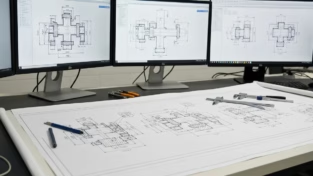
Step-by-step tutorial for creating your first CAD drawing in AutoCAD — engineering workstation, Australia

Learning how to create your first CAD Drawing can feel overwhelming at first, but once you understand the process, it becomes an exciting and rewarding skill. Whether you’re an aspiring engineer, architect, designer, or student, mastering computer-aided design (CAD) gives you the ability to bring ideas to life with precision and creativity.

In this beginner-friendly tutorial, we’ll guide you step-by-step through the process of creating your first CAD Drawing, from setting up your software to finalizing your design for presentation or printing.


What is a CAD Drawing?

A CAD Drawing is a digital representation of an object, building, or mechanical part created using Computer-Aided Design (CAD) software. Unlike hand drafting, CAD drawings are accurate, easy to modify, and can be stored or shared digitally.

They’re widely used in industries such as:

  • Architecture: for floor plans and structural layouts
  • Mechanical Engineering: for parts, assemblies, and tools
  • Electrical Design: for wiring diagrams and circuit layouts
  • Civil Engineering: for roads, bridges, and land development plans

Step-by-Step Tutorial: How to Create Your First CAD Drawing

Step 1: Choose the Right CAD Software

The first step in your CAD journey is choosing a suitable program. Popular CAD software options include:

  • AutoCAD – great for 2D and 3D drafting
  • SolidWorks – ideal for mechanical part design
  • Fusion 360 – user-friendly for beginners and hobbyists
  • DraftSight or FreeCAD – perfect for those starting out on a budget

For beginners, AutoCAD or Fusion 360 are often the best starting points due to their tutorials and large online communities.


Step 2: Set Up Your Drawing Environment

Once you open your CAD software, set up your workspace.

  • Define units: Decide whether you’ll use millimeters, centimeters, or inches depending on your project.
  • Set limits: This defines the drawing area or boundary of your design.
  • Adjust grid and snap settings: The grid helps you align and control precision in your CAD Drawing.

These small setup steps ensure your design remains accurate and consistent.


Step 3: Create Basic Geometry

Now it’s time to start drawing!
Use simple shapes like lines, circles, rectangles, and arcs to build your base design.

For example:

  • Type LINE or click the line tool to draw straight lines.
  • Use CIRCLE or ARC to draw curves or round edges.
  • Use OFFSET or TRIM to fine-tune the shapes.

Each CAD command helps you create geometry faster and more precisely than traditional hand drafting.


Step 4: Use Layers to Organize Your Drawing

Layers are a vital feature in CAD software. Think of them as transparent sheets stacked on top of each other — each one containing a different part of your drawing.

For example:

  • Layer 1: Walls
  • Layer 2: Dimensions
  • Layer 3: Electrical Layout
  • Layer 4: Annotations

Using layers in your CAD Drawing helps you control visibility, color, and line types — making your project more organized and professional.


Step 5: Add Dimensions and Annotations

A drawing is incomplete without measurements.
Use the Dimension tool to label distances, angles, and diameters.

Annotations can include:

  • Text labels (for part names or room numbers)
  • Notes (for special instructions)
  • Symbols (like arrows or welding marks)

Adding clear annotations ensures anyone reviewing your drawing understands the design intent without confusion.


Step 6: Apply Line Types and Thickness

Different line types represent different objects or functions:

  • Solid lines for visible edges
  • Dashed lines for hidden details
  • Center lines for symmetrical parts

Adjusting line weights and colors gives your CAD Drawing a professional appearance and makes it easier to interpret.


Step 7: Check and Clean Up Your Drawing

Before finalizing, it’s important to check for:

  • Overlapping lines or gaps
  • Incorrect dimensions
  • Misaligned parts

Use tools like OVERKILL or AUDIT (in AutoCAD) to clean and verify your drawing. A clean, error-free file ensures accuracy and professionalism.


Step 8: Save, Print, or Export Your CAD Drawing

Finally, save your project in multiple formats:

  • .DWG or .DXF – Standard CAD formats for editing
  • .PDF – For sharing or printing
  • .STL or .STEP – For 3D modeling or manufacturing

Always save multiple backups of your work to prevent data loss. Once done, you can print your CAD Drawing or share it with clients, teachers, or collaborators.


Pro Tips for Beginners in CAD Drawing

  • Learn shortcuts: Commands like L (Line), C (Circle), M (Move), and TR (Trim) save time.
  • Use templates: Predefined templates speed up setup and ensure standardization.
  • Practice regularly: The more you practice, the faster you’ll master CAD tools.
  • Watch tutorials: YouTube and online courses offer visual guidance for beginners.
  • Start simple: Begin with basic shapes before moving on to complex designs.

Conclusion

Creating your first CAD Drawing is an exciting milestone for any beginner. With the right software, organized workflow, and consistent practice, you can transform your ideas into precise digital blueprints.

Whether you’re designing a simple part or a complex architectural layout, CAD technology opens the door to endless design possibilities. So, fire up your CAD software, follow these steps, and start drafting your very first creation today!

What is CAD drafting — AutoCAD technical drawings and blueprints on engineering workstation in Australia

CAD drafting — short for Computer-Aided Design drafting — is the process of creating precise, detailed technical drawings using specialised software. It is the universal language of engineering and construction in Australia, replacing hand drafting from the 1980s onwards and becoming the foundation of every project from residential renovations through to major infrastructure. Whether you’re an engineer, project manager, architect, or builder, understanding what CAD drafting is and how it works helps you communicate more effectively with your drafting team and make better decisions for your project.

This guide covers the definition of CAD drafting, the different types, the software used, the key disciplines it covers in Australia, and why businesses choose to outsource it. If you’re looking for professional CAD drafting services across Brisbane, Sydney, Melbourne, Perth, or Gold Coast — or you’re simply trying to understand what your drafting provider actually does — you’re in the right place.


CAD drafting is the use of computer software to produce technical drawings — the precise, dimensioned, and standards-compliant documents that engineers, fabricators, builders, and councils use to construct or approve projects. It replaced traditional hand drafting (pencil on paper over a tilted drawing board) and is now the universal standard across all engineering and construction disciplines globally.

At its core, CAD drafting captures two things: geometry — the exact shape and dimensions of objects — and annotation — the notes, symbols, tolerances, and specifications that tell someone how to build it. A CAD drawing is not simply a picture. It is a precise technical document with legal and contractual significance, used to obtain council approvals, guide fabricators, and direct tradespeople on site.

In Australia, CAD drafting is governed by standards including AS1100 (Technical Drawing Standards) and the National Construction Code (NCC), which specify how drawings must be formatted, dimensioned, and labelled to be legally compliant and usable by contractors and councils.


Before CAD software, draftspeople worked at tilted drawing boards using pencils, rulers, set squares, and technical pens. Every line was drawn by hand, every revision required erasing and redrawing, and producing a full set of construction drawings could take weeks of skilled labour.

CAD software transformed this process completely. The key advantages over manual drafting are:

  • Speed: drawings that took days by hand can be completed in hours using CAD software.
  • Accuracy: dimensions are mathematically precise — there is no human measuring error in line placement or scaling.
  • Revisions: changing a design means editing the digital file, not starting over. Revisions that once took days now take minutes.
  • Reusability: components, drawing blocks, and standard details can be saved in libraries and reused across projects.
  • Collaboration: CAD files can be shared instantly with engineers, fabricators, builders, and councils anywhere in Australia or the world.
  • 3D capability: modern CAD software generates three-dimensional models that can be visualised, rotated, analysed, and simulated before a single piece of material is ordered.

CAD drafting encompasses a broad range of drawing types, outputs, and methodologies. Understanding the main categories helps you communicate clearly with your drafting provider and ensure you’re commissioning the right type of work for your project.

2D CAD drafting produces flat, plan-view drawings — floor plans, elevations, sections, construction details, schematics, and fabrication drawings. This is the most commonly requested output in construction and engineering. AutoCAD is the industry standard for 2D drafting and is used across mechanical, structural, electrical, architectural, and civil disciplines throughout Australia. 2D drawings are submitted for council approval, used on construction sites, and issued to fabricators for manufacturing.

3D CAD modelling creates three-dimensional digital representations of parts, assemblies, structures, or buildings. Software like SolidWorks, Inventor, and Fusion 360 are used for mechanical and product design, while Revit is used for architectural and structural 3D modelling. 3D models allow engineers to visualise designs before construction, run stress analyses and simulations, generate accurate material quantities, detect design clashes before they become costly site problems, and produce photorealistic renders for client approval.

BIM is an advanced form of 3D modelling that embeds data into the model — not just geometry, but specifications, costs, schedules, and performance data. A BIM model of a building contains information about every structural member, every pipe, every door — allowing project teams to coordinate design across all disciplines, detect clashes between structure, services, and architecture, and manage the asset through its entire lifecycle. Revit is the dominant BIM platform in Australia, and BIM is increasingly mandated on government infrastructure and commercial projects.

Schematic drafting is used in electrical engineering to produce single line diagrams, panel layouts, P&IDs (Piping and Instrumentation Diagrams), and wiring diagrams. Software like AutoCAD Electrical and EPLAN are used for these specialised outputs. Unlike plan drawings, schematics are not drawn to scale — they show logical connections and system relationships rather than physical geometry and placement.


CAD drafting is used across every engineering discipline in Australia. Each has its own standards, preferred software, and drawing conventions that drafters must understand deeply to produce compliant, usable documentation.

Mechanical CAD drafting covers machine components, assemblies, manufacturing drawings, fabrication details, sheet metal design, and product development. It requires deep knowledge of tolerancing (GD&T), material properties, and manufacturing processes. Software used includes AutoCAD, SolidWorks, and Inventor. ASTCAD’s mechanical drafting services serve mining, aerospace, marine, automotive, and industrial manufacturing clients across Australia.

Structural CAD drafting produces drawings for steel, concrete, and timber structures — including structural steel shop drawings, reinforcement drawings, connection details, and AS/NZS-compliant structural documentation. Structural drafting works alongside structural engineers and must comply with Australian standards including AS4100 (steel structures) and AS3600 (concrete structures). Explore our structural drafting services for more detail on what’s involved.

Electrical CAD drafting covers schematics, panel drawings, single line diagrams, wiring diagrams, and electrical layouts for commercial, industrial, and residential projects. Australian electrical drawings must comply with AS/NZS 3000 (the Wiring Rules) and relevant industry codes. Our electrical drafting team works with electricians, electrical engineers, and OEM manufacturers across Brisbane, Sydney, Melbourne, and Perth.

Architectural CAD drafting produces floor plans, elevations, sections, 3D renders, development application (DA) drawings, and construction documentation for residential, commercial, and industrial buildings. In Australia, architectural drawings submitted for council approval must meet specific formatting and content requirements under the NCC and each council’s local planning scheme. Accuracy and compliance at DA stage can save months of back-and-forth with local authorities.

Civil CAD drafting covers roads, drainage, stormwater, sewerage, earthworks, and site development drawings. Civil drafters typically use AutoCAD Civil 3D and must produce documentation compliant with local council infrastructure standards and the AGRD (Australian Guide to Road Design). Our civil drafting services support land developers, civil engineers, and local governments across Australia.


The software used depends on the discipline and type of output required. Here are the most commonly used CAD platforms in Australian engineering and construction in 2026:

  • AutoCAD: the universal industry standard for 2D drafting across all disciplines — used by the vast majority of Australian drafters.
  • Revit: the dominant BIM platform for architectural, structural, and MEP (mechanical, electrical, plumbing) design in Australia.
  • SolidWorks: the leading software for mechanical product design, assemblies, and manufacturing drawings.
  • Inventor: Autodesk’s mechanical CAD and product simulation platform, widely used in Australian manufacturing and industrial design.
  • Civil 3D: Autodesk’s civil engineering platform for road design, drainage, earthworks, and land development.
  • MicroStation / OpenRoads: used primarily on major infrastructure and government projects in Australia, particularly for transport and utilities.
  • Navisworks: used for BIM model coordination, multi-discipline clash detection, and 4D construction simulation.

Many engineering firms, builders, and manufacturers outsource their CAD drafting to specialist companies rather than employing full-time in-house drafters. The reasons are straightforward:

  • Cost efficiency: outsourcing avoids the full cost of employment — superannuation, leave entitlements, equipment, ongoing training, and office space are all transferred to the provider.
  • Scalability: project workloads fluctuate. Outsourcing lets you scale drafting resources up or down without the complexity and cost of hiring or making staff redundant.
  • Access to specialists: a full-service CAD company has mechanical, structural, electrical, architectural, and civil drafters — giving you access to every discipline without maintaining separate specialist employees.
  • Turnaround speed: established CAD companies have proven workflows, drawing templates, and block libraries that allow faster delivery than building that capability in-house from scratch.
  • Software and licensing: professional CAD software licences are expensive and require ongoing maintenance. Outsourcing transfers that cost and responsibility to the provider.

CAD drafting is used to produce technical drawings for engineering, construction, and manufacturing projects. Common applications include architectural floor plans and council documentation, structural steel shop drawings, mechanical fabrication drawings, electrical schematics and panel layouts, civil engineering road and drainage plans, product design drawings for manufacturing, and 3D models for simulation, rendering, and 3D printing.

Drafting is the broader discipline of producing technical drawings — it existed long before computers, using pencil and paper on a drawing board. CAD (Computer-Aided Design) is the computer-based method of performing that same work. In modern professional practice in Australia, CAD drafting and drafting are effectively synonymous — virtually all technical drawing is now done using CAD software rather than by hand.

Engineers design — they determine what needs to be built, perform calculations, and take professional responsibility for the design. CAD drafters document — they translate the engineer’s design intent into precise, construction-ready drawings. Most projects need both. Many CAD companies (including ASTCAD) employ licensed engineers on staff who can provide both engineering design and drafting services under one roof, simplifying the project management process significantly.

CAD drawings are mathematically precise — dimensions in a CAD file are exact to whatever unit of measurement is used. Accuracy in a delivered drawing depends on the quality of the input information and the skill of the drafter. A CAD drafter working from a good brief, accurate survey data, and clear engineering input will produce drawings accurate to fractions of a millimetre. This precision is one of the primary advantages of CAD over manual drafting, which introduced human measurement error at every step.

The most common CAD file formats in Australia are DWG (AutoCAD’s native format and the universal industry standard), DXF (Drawing Exchange Format for cross-software compatibility), PDF (for distribution, review, and council submission), RVT (Revit’s native BIM format), and SLDPRT/SLDASM (SolidWorks part and assembly files). Always confirm what format your fabricator, contractor, or engineer requires before work commences — most CAD companies can deliver in multiple formats at no extra cost.

Look for a company with licensed engineers overseeing the work, demonstrated experience in your specific discipline, a clear familiarity with Australian Standards, and a transparent quoting and revision process. Ask to see samples of comparable work, confirm their software matches your project requirements, and check whether they have a local Australian presence — particularly important for projects requiring site visits, council liaison, or direct collaboration with your engineering team.


ASTCAD is a Brisbane-based CAD design and drafting company serving engineering firms, builders, manufacturers, and architects across Australia. With expertise across mechanical, structural, electrical, architectural, and civil disciplines, our team delivers accurate, standards-compliant drawings with a 24-hour quote turnaround. Get your free quote today.

What is CAD drafting used for?

CAD drafting is used to produce precise technical drawings for engineering, construction, and manufacturing projects across Australia. We create architectural floor plans, structural shop drawings, mechanical fabrication drawings, electrical schematics, and civil engineering plans that meet Australian Standards and building codes. Our CAD services help engineers, architects, and contractors visualize projects, streamline construction processes, and ensure compliance with local regulations before work begins on site.

What is the difference between CAD and drafting?

Drafting is the discipline of creating technical drawings that communicate design intent, while CAD is the computer technology that enables this work. In Australia’s engineering and construction sectors, these terms are now virtually interchangeable since almost all professional drafting relies on CAD software like AutoCAD or Revit. We use CAD tools to produce drawings that comply with Australian Standards and support building approvals, ensuring precision and efficiency that manual drafting simply cannot match.

Do I need a CAD drafter or an engineer?

Engineers design and take professional responsibility for the design, while CAD drafters translate that vision into precise, construction-ready drawings. Most Australian projects require both roles working together. We recommend consulting an engineer for complex structural or compliance work, then having a CAD drafter prepare detailed drawings for builders and council submissions. ASTCAD has licensed engineers on staff who can provide both services, ensuring your project meets Australian building codes and standards from concept through construction documentation.

Claude AI and Autodesk Fusion 360 CAD automation workflow

Anthropic’s Claude AI has become one of the most capable tools for engineering automation — and its integration with Autodesk Fusion 360 via the Fusion API represents a significant shift in how CAD modelling workflows can be structured. Where traditional CAD automation required dedicated programming knowledge (Python, C++, or Fusion’s JavaScript API), Claude can now generate, debug, and iterate Fusion 360 scripts from plain-English descriptions of the design intent.

This article covers what the Claude–Fusion 360 integration actually does, how Australian engineers and drafters can use it to automate repetitive modelling tasks, and where AI-assisted CAD design fits into a professional engineering workflow.

How Claude Integrates with Autodesk Fusion 360

Autodesk Fusion 360 exposes its full modelling capability through a Python-based API. Every feature you can create manually in Fusion — sketches, extrusions, fillets, holes, sheet metal bends, assemblies, drawings — can also be created programmatically through this API. Historically, using this API required Python knowledge and familiarity with Fusion’s object model documentation.

Claude changes this equation. Because Claude has deep knowledge of the Fusion 360 API and Python, you can describe a part or feature in plain English and Claude will generate the script to create it. More importantly, Claude can iterate — if the first script produces a part with the wrong dimensions or an unexpected geometry, you describe what’s wrong and Claude modifies the script accordingly. The feedback loop that previously required a programmer is now accessible to any engineer who can describe their design intent clearly.

In 2025, Autodesk also launched an official Claude integration within Fusion 360 as part of the Autodesk AI ecosystem, allowing Claude to be invoked directly inside the Fusion environment. This means engineers can query design parameters, generate API scripts, and get contextual help without leaving the CAD environment.

What You Can Automate with Claude and Fusion 360

Parametric Part Generation

The most direct use case is generating parametric parts from a specification. Rather than manually building a SolidWorks or Fusion model from scratch, you can give Claude a part description — material, key dimensions, feature requirements — and it will produce a Fusion 360 API script that builds the part programmatically.

For example: a structural bracket used repeatedly across a mining equipment range with varying width, height and bolt-hole pattern can be scripted once as a parametric Fusion model. Claude generates the API script from a description of the bracket geometry and the parameter table; the engineer runs the script, checks the output, and the parametric model is ready for the full range of variants — without manually rebuilding each one.

For Australian fabricators producing families of similar components (conveyor idler frames, equipment mounting brackets, switchboard enclosures), this reduces the modelling time per variant from hours to minutes.

Automating Drawing Sheet Production

Fusion 360’s drawing environment is also accessible via API. Claude can generate scripts that automate drawing sheet creation from a 3D model: specifying the view arrangement (front, top, right side — third-angle projection per AS 1100.201), setting the scale, populating the title block with project metadata, and placing standard drawing notes.

For a fabrication shop producing repetitive drawing packages — say, 50 structural steel bracket variants all requiring the same drawing template — Claude-generated automation can produce the entire drawing set in a fraction of the time required manually. The engineer’s role shifts to checking the output and adding any non-standard annotations, rather than manually setting up each sheet.

BOM (Bill of Materials) Generation and Export

Claude can write Fusion 360 API scripts that extract assembly BOM data — part numbers, descriptions, materials, quantities, masses — and export it in any format required: CSV for procurement, Excel for project management, or a custom format matching a client’s document control system. For Australian projects using document management systems like Aconex or Procore, Claude can generate scripts that format and export BOM data to match the platform’s import template.

Design Variant Generation for Generative Design Inputs

Autodesk’s Generative Design feature (covered in our AI in CAD article) requires setting up preserve geometry, obstacle geometry, and load cases. Claude can assist by generating the API scripts that set up the generative design study parameters from a structured brief — translating an engineer’s load specification and manufacturing constraints into the Fusion API calls that configure the study correctly.

Sheet Metal Flat Pattern Automation

Fusion 360’s sheet metal environment is well-suited to automation. Claude can generate scripts that create sheet metal parts from a flat blank specification, apply bend parameters (K-factor, bend radius, relief type) consistent with a specific material and gauge — for example, AS/NZS 1734 aluminium alloy 5052-H32 at 2mm gauge with a 2.5mm inside bend radius — and export the flat pattern DXF directly for laser cutting or punch press programming.

For Australian sheet metal fabricators producing enclosures, brackets, and covers in families of related parts, this automation can eliminate the manual flat-pattern creation step almost entirely for standard parts.

A Practical Example: Generating a Parametric Weld Bracket

To make this concrete, here’s how a typical Claude–Fusion 360 automation interaction works for a structural weld bracket:

Engineer’s prompt to Claude:
“Create a Fusion 360 API script that builds a gusset bracket from 10mm AS/NZS 3678 Grade 350 plate. The bracket has a vertical plate 150mm high × 100mm wide, a horizontal plate 100mm wide × 80mm deep, and a triangular gusset joining them. Two M16 holes on the vertical face at 60mm and 110mm from the bottom, centred horizontally. All corners have 5mm fillets. Output as a single body ready for FEA.”

What Claude produces: A complete Python script using the Fusion 360 API that creates the sketch profiles, extrudes each plate, creates the gusset from a triangular profile, applies the fillets, adds the hole features, and assigns the material as structural steel. The script includes parameter variables at the top so the engineer can change any dimension without editing the body of the script.

Engineer’s follow-up:
“The gusset is showing as a separate body — combine all bodies into one and add a 3mm fillet along the gusset-to-vertical plate join.”

Claude’s correction: Adds a Combine operation and a second fillet feature to the script. Total iteration time: under 2 minutes, versus 15–20 minutes to manually model and re-model the same change in Fusion’s GUI.

How ASTCAD Uses Claude-Assisted Automation

At ASTCAD, we have integrated Claude into our CAD workflow for specific high-volume and repetitive tasks. The areas where it delivers the most measurable time saving for our Australian clients are:

  • Mining equipment variant families: Generating parametric models for bracket, frame, and enclosure families where the same geometry repeats across 10–50 size variants. Claude scripts the parametric model; the engineer reviews and approves each variant against the client’s load specification.
  • Sheet metal enclosure families: AS/NZS 1734 aluminium and AS 1397 galvanised steel enclosures for electrical and instrumentation panels across different equipment platforms — same geometry, different sizes. Claude-generated flat pattern scripts feed directly to the client’s laser cutting DXF requirements.
  • Drawing template automation: Automating the application of ASTCAD’s title block, layer standards, and standard drawing notes across large drawing sets, eliminating the manual setup step for each new drawing.
  • BOM extraction for mining documentation: Generating BOM export scripts formatted for specific Pilbara and Goldfields operator document management systems — Aconex, ProjectWise, or proprietary plant register formats.

What Claude Cannot Do in a CAD Workflow

It’s worth being direct about the current limitations, because inflated expectations lead to poor adoption decisions:

  • Claude cannot take engineering responsibility. Scripts generated by Claude must be reviewed by the engineer before use in production. A generated script that produces a geometrically correct model may still have incorrect material assignments, missing features, or design decisions that don’t match the project’s structural or compliance requirements. The engineer checks and approves; Claude produces the draft.
  • Claude cannot access your live Fusion environment without the API integration. When using Claude via claude.ai or the Claude API directly, you paste the generated script into Fusion’s script editor and run it — Claude doesn’t control Fusion directly unless you’ve set up the Autodesk AI integration or a custom API bridge. The Autodesk-native Claude integration (available in Fusion 360 2025) does provide a more direct in-environment experience.
  • Complex organic or freeform surfaces still require manual modelling. Claude-generated Fusion scripts work best for prismatic, sheet metal, and parametric geometry. Organic surfacing, Class-A automotive surfaces, and complex freeform shapes require the engineer’s direct modelling skill — Claude’s scripting capability doesn’t extend to these effectively yet.
  • Verification against Australian Standards is the engineer’s task. Claude will generate scripts that produce geometrically valid models; it will not automatically verify that a structural member section is adequate under AS 4100, that a sheet metal gauge is sufficient for the load case, or that a bolted connection meets AS 4100 Section 9 requirements. That verification is the engineer’s professional responsibility.

Getting Started: Using Claude for Fusion 360 Automation

For Australian engineers who want to start using Claude for Fusion 360 automation, the practical entry points are:

  1. Use Claude via claude.ai or Claude API to generate Fusion 360 Python scripts. Paste the script into Fusion → Utilities → Scripts and Add-Ins → Scripts → Create → run it in the Fusion script editor. This works without any special integration setup.
  2. Use the Autodesk AI integration in Fusion 360 2025 for in-environment access — available via the Autodesk Construction Cloud and Fusion 360 subscription. This provides a more integrated experience where Claude can see the current model state.
  3. Start with a clear, structured brief. Claude produces better scripts when you specify: part geometry systematically, material grade and standard (e.g. AS/NZS 3678 Grade 350, not just “steel”), key dimensions in mm, hole sizes and patterns, surface finish requirements, and the intended output (single body, assembly, drawing sheet).
  4. Build a library of working scripts. Once Claude generates a script that works for a part type, save it as a template. Future variants can be produced by asking Claude to modify the template’s parameters rather than generating from scratch each time.

Frequently Asked Questions

Can Claude AI control Autodesk Fusion 360 directly?

There are two modes. When using Claude via claude.ai or the API, Claude generates Fusion 360 Python scripts that you paste and run in Fusion’s built-in script editor — Claude doesn’t directly control the application, but it generates working code you execute. Autodesk’s native AI integration in Fusion 360 2025 provides a more direct in-environment experience where Claude can be invoked within the Fusion interface and has access to the current model context. Both approaches are genuinely useful; the direct integration is more seamless, while the script-generation approach works with any version of Fusion that supports the Python API.

What types of CAD tasks can Claude automate in Fusion 360?

Claude can generate Fusion 360 API scripts for: creating parametric part models from specifications, building sheet metal flat patterns with correct bend parameters, generating drawing sheets from 3D models with specified view arrangements, extracting and formatting BOM data, setting up generative design study parameters, and batch-processing design variants across a parameter table. The strongest applications are repetitive, well-defined tasks where the same geometry appears across many variants — equipment families, enclosure ranges, bracket catalogues.

Do I need to know Python to use Claude for Fusion 360 automation?

No prior Python knowledge is required to use Claude-generated scripts — you can copy and paste a script Claude produces into Fusion’s script editor and run it without understanding the code. However, some Python familiarity makes it easier to understand what Claude has generated, to spot errors, and to ask Claude for targeted modifications. Engineers who invest a few hours understanding the basics of Python function structure and the Fusion 360 API object model get significantly more value from Claude automation, because they can give Claude more precise modification instructions when the first script needs adjustment.

Is Claude-assisted CAD automation suitable for Australian engineering projects?

Yes, for the right tasks. Claude-generated Fusion 360 automation is most suitable for: families of similar components across a product range, repetitive drawing production where the template and view arrangement are standardised, BOM extraction for document management systems, and sheet metal flat pattern generation for standard gauges and materials. It is not a substitute for the engineer’s technical judgement on material selection, compliance with Australian Standards, or structural adequacy — those remain professional responsibilities that Claude assists with rather than replaces.


Related articles: How AI is Transforming CAD Drafting in Australia (2025–2026) | Mechanical Drafting Services | Sheet Metal Design Handbook

JH

James Hartley

Senior Mechanical Engineer · BEng (Mechanical), UQ · Member, Engineers Australia · ASTCAD, Brisbane

James has 14 years of hands-on experience delivering CAD design, structural drafting, and engineering documentation across Australia’s mining, oil & gas, and manufacturing sectors. He specialises in SolidWorks, Autodesk Inventor, and AutoCAD for complex multi-discipline projects.

More articles by James Hartley →
Engineer reviewing CAD drafting cost estimates for Australian project

Understanding CAD drafting cost in Australia is the first step to budgeting your engineering or construction project accurately. If you’re planning an engineering or construction project and considering outsourcing your CAD work, one of the first questions you’ll ask is: how much does CAD drafting cost in Australia? The honest answer is that it varies significantly — but understanding what drives those costs will help you budget accurately and avoid paying more than you should. This guide breaks down real 2026 pricing for CAD drafting services across Australia, from simple 2D drawings through to complex 3D modelling and full project documentation sets.


What Affects the Cost of CAD Drafting in Australia?

CAD drafting costs in Australia aren’t fixed — they depend on several factors that any reputable provider will assess before quoting. Understanding these factors will help you compare quotes more accurately and spot providers who are either overcharging or cutting corners.

Project Complexity

A simple 2D floor plan for a small residential renovation is a fundamentally different task from a full structural steel shop drawing set for an industrial facility. Complexity directly drives cost — the more detailed, coordinated, and technically demanding the drawings, the higher the rate and the more hours required. Projects that require compliance with Australian Standards (such as AS1100 for technical drawings or the NCC for building documentation) also require additional care and expertise.

Discipline

Different engineering disciplines command different rates. Mechanical and structural drafting typically sits at the higher end of the scale because it requires specialist knowledge of tolerances, material properties, and fabrication processes. Architectural drafting ranges in the middle. Civil and electrical drafting varies depending on the scope. As a rule of thumb, the more specialised the discipline, the higher the hourly rate.

Software Required

Most projects have software requirements — whether that’s AutoCAD, SolidWorks, Revit, Inventor, MicroStation, or Civil 3D. If your project requires a less common platform or specific version compatibility, this can affect cost. Providers who maintain licences across a broad range of software (as any full-service CAD company should) are better positioned to serve complex, multi-discipline projects without surprises.

Turnaround Time

Rush jobs cost more. If you need drawings within 24–48 hours, expect to pay a premium — typically 20–50% above standard rates. Conversely, projects with flexible timelines often attract more competitive pricing because the provider can schedule the work efficiently alongside other projects.

Onshore vs Offshore Providers

Australia has both locally based CAD companies and offshore providers (typically based in India or the Philippines) that serve Australian clients remotely. Offshore providers generally quote lower rates, but the tradeoff includes communication delays, potential misalignment with Australian Standards, and less accountability. Australian-based teams — particularly those with licensed engineers overseeing the work — provide greater confidence for projects where compliance, IP protection, and direct communication are priorities.


CAD Drafting Rates in Australia — What to Expect in 2026

Based on current market rates across Brisbane, Sydney, Melbourne, and Perth, here is a realistic pricing guide for CAD drafting costs in Australia in 2026:

Dedicated drafter (staff leasing, per hour): $35–$75/hr

Hourly rate (general CAD drafting): $45–$120/hr, depending on discipline and provider type

Architectural drafting: $80–$130/hr

Mechanical drafting (2D): $85–$140/hr

Structural drafting: $90–$150/hr

Electrical/schematic drafting: $75–$120/hr

3D CAD modelling: $100–$160/hr

BIM modelling (Revit): $95–$150/hr

Simple 2D drawing (single sheet): $150–$500 per drawing

Residential DA drawing set: $800–$2,500

Commercial construction documentation: $3,000–$15,000+

Industrial/engineering project set: $2,500–$20,000+

Keep in mind these are market averages — a highly experienced licensed mechanical engineer drafting a complex FEA-linked assembly will sit at the top of the range, while a straightforward as-built drawing for a small fitout will sit at the lower end.


Hourly vs Project-Based Pricing — Which is Better?

Hourly pricing works best when the project scope is uncertain, evolving, or likely to involve revisions. It protects you from paying a large upfront fee for a scope that changes. The downside is less cost certainty — if the project takes longer than expected, your bill grows accordingly. Always ask for an estimated hour range before proceeding.

Project-based (fixed-fee) pricing works best when your scope is clearly defined — for example, a specific number of drawings to a known standard, with a defined revision allowance. Fixed fees give you full cost certainty and incentivise the provider to work efficiently.

For ongoing relationships — such as having a dedicated drafter work alongside your team — staff leasing arrangements offer the best value, typically at $35–$75/hr for a committed resource without the overhead of employment.


How to Get an Accurate Quote for CAD Drafting

  • Scope of work: List each deliverable — floor plans, elevations, sections, fabrication drawings.
  • Input documents: Sketches, PDFs, existing CAD files, or starting from scratch?
  • Software format required: DWG, DXF, Revit, SolidWorks, PDF?
  • Australian Standards: AS1100, NCC, or relevant industry codes?
  • Revision allowance: How many rounds of changes are you expecting?
  • Timeline: When do you need the drawings, and are any stages time-critical?

At ASTCAD, we provide obligation-free quotes for all disciplines — mechanical, structural, electrical, architectural, and civil — across Brisbane, Sydney, Melbourne, Perth, and Gold Coast. Contact our team with your project details, and we’ll turn around a clear, itemised quote within 24 hours.


Frequently Asked Questions

Is it cheaper to use an offshore CAD drafting company?

Offshore providers typically quote lower hourly rates — often $15–$35/hr compared to $75–$150/hr for Australian providers. However, the total project cost is rarely as low as the rate suggests once you factor in additional revision rounds, time zone delays, and drawings that may not align with Australian Standards. For projects where compliance, IP, and communication matter, Australian-based providers generally offer better overall value.

How long does a typical CAD drafting project take?

Timelines vary by project type. A single floor plan: 4–8 hours. A residential DA set: 2–5 business days. A commercial documentation package: 2–4 weeks. Industrial multi-discipline projects: several weeks to months. Always confirm your timeline in writing, especially for time-sensitive work.

What’s the difference between CAD drafting and engineering design?

CAD drafting produces the technical drawings — dimensioned, standards-compliant documents used by contractors and councils. Engineering design is the broader process of determining what needs to be built and how. Many full-service firms like ASTCAD offer both, so clients can work with one provider from concept through to construction-ready documentation.

Ready to Get a Quote?

ASTCAD is a Brisbane-based CAD design and drafting company serving clients across Australia, covering all engineering disciplines with transparent, fixed-fee pricing and a 24-hour quote turnaround. Get your free, no-obligation quote today.


CS

Claire Sutton

Architectural CAD Specialist & Technical Writer · BArch (Hons), QUT · ASTCAD, Brisbane

Claire has 10 years of experience in Revit BIM modelling, architectural documentation, and CAD conversion projects across Southeast Queensland and NSW. She has delivered NCC-compliant documentation for residential, commercial, and industrial facilities.

More articles by Claire Sutton →
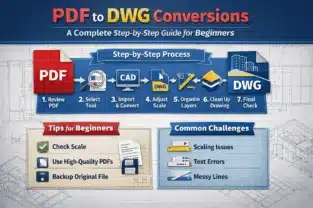
PDF TO DWG CONVERSIONS

In today’s design and engineering workflows, drawings are often shared in PDF format because it’s easy to view, print, and distribute. However, when you need to edit, modify, or reuse drawings, PDFs quickly become a limitation. This is where PDF to DWG conversions play a crucial role.

Whether you’re an architect, engineer, contractor, or CAD beginner, understanding how to convert PDF files into editable DWG format can save time, reduce rework, and improve accuracy. This beginner-friendly guide walks you through the entire PDF to DWG conversion process, tools, challenges, and best practices.


What is PDF to DWG conversion?

PDF to DWG conversion is the process of transforming a PDF drawing into a DWG file, which is the native format used by AutoCAD and other CAD software. Once converted, the drawing becomes fully editable, allowing users to modify dimensions and layouts, edit layers and annotations, reuse existing designs, and extract accurate CAD data.

PDF to DWG conversions are commonly used for legacy drawings, as-built plans, and scanned documents.


Why PDF to DWG conversion is important

  • Editable drawings: Convert static PDFs into fully editable CAD files
  • Cost efficiency: Avoid redrawing from scratch
  • Accuracy improvement: Maintain scale and geometry
  • Better collaboration: DWG files are easier to share and revise
  • Time saving: Faster updates and revisions

Types of PDFs used for conversion

1. Vector-based PDFs

Created directly from CAD software, vector PDFs contain actual lines, arcs, and text objects. These are far easier and more accurate to convert — the geometry is already defined mathematically, so conversion tools can extract it cleanly.

2. Raster-based (scanned) PDFs

Created by scanning paper drawings, raster PDFs are essentially images. They require additional cleanup and tracing after conversion. Quality depends heavily on scan resolution — a 300 DPI scan will convert significantly better than a faded 72 DPI photocopy.


Step-by-step guide: PDF to DWG conversion for beginners

Step 1: Review the PDF file

Check drawing scale and clarity, identify layers, text, and dimensions, and determine whether the source is a scanned or vector-based PDF. This determines your tool choice and how much manual cleanup to expect.

Step 2: Choose the right conversion tool

Common options include AutoCAD’s built-in PDF import (PDFIMPORT command), online PDF to DWG converters, dedicated CAD conversion software, and professional conversion services. For beginners, AutoCAD’s built-in tools are a reliable starting point for vector PDFs.

Step 3: Import or convert the PDF

Open AutoCAD, use the PDFIMPORT command, select your PDF file, choose the relevant pages, and adjust import settings. For scanned PDFs, you’ll need a raster-to-vector tracing step first.

Step 4: Check scaling and units

Verify drawing units (mm, inches, metres) and use known reference dimensions to confirm the scale is correct before editing anything. Scaling errors caught early save significant rework later.

Step 5: Organise layers

Separate walls, dimensions, text, and symbols into named layers. Delete unnecessary elements. A well-layered DWG is far easier to work with and is expected by most engineering and architecture clients.

Step 6: Clean and edit the drawing

Remove duplicate lines, fix broken geometry, align misinterpreted elements, and convert exploded text back into editable text objects. This is the most time-consuming step for raster-source conversions.

Step 7: Final quality check

Verify dimensions against the original PDF, check alignment and accuracy, and save in the required DWG version for your client or project requirements.


Common challenges in PDF to DWG conversions

  • Incorrect scaling after import
  • Text converted as polylines instead of editable text
  • Extra or broken lines from PDF compression artefacts
  • Missing or incorrectly mapped layers
  • Poor quality scanned PDFs producing unusable geometry

Best PDF to DWG conversion tips

  • Always verify scale after conversion using a known dimension
  • Use high-resolution PDFs (300 DPI minimum for scanned drawings)
  • Clean the drawing before starting new edits
  • Don’t over-trust auto-conversion tools — always manually review critical dimensions
  • Keep a backup of the original PDF before making any edits

What is the best software for PDF to DWG conversion?

At ASTCAD, we recommend AutoCAD’s built-in PDF import for straightforward conversions, though it works best with simpler drawings. For more complex Australian construction or engineering projects involving multiple layers or precise specifications, we suggest dedicated conversion software or our professional conversion services. We’ve found that outsourcing to specialists like us ensures accuracy with local building standards and compliance requirements, saving you time and potential rework costs.

Can scanned PDFs be converted to DWG?

Yes, we can convert scanned PDFs to DWG, though the process requires additional work since scanned files are raster-based images rather than vector data. The accuracy of your conversion depends heavily on the original scan quality, and you’ll typically need to perform manual editing and cleanup to ensure the DWG file meets Australian building standards and complies with relevant engineering specifications. We recommend starting with high-resolution scans and allowing extra time for vectorization if precision is critical for your project.

Is PDF to DWG conversion 100% accurate?

No automatic conversion is 100% accurate, and we always recommend manual verification and editing to ensure precision. PDF files often contain embedded fonts, complex layering, or compressed data that don’t translate perfectly to DWG format, particularly with technical drawings common in Australian construction and engineering standards. We suggest reviewing converted files carefully and adjusting line weights, layers, and dimensions to meet your project requirements. Our team can assist with quality checking if needed.

How long does a PDF to DWG conversion take?

The conversion time depends on your file’s complexity and type. Simple vector PDFs typically convert in minutes, while complex drawings or scanned documents may take several hours. At ASTCAD, we recommend uploading your files during business hours so our team can prioritise them if needed. For urgent projects, contact us directly to discuss expedited processing options that suit Australian construction and engineering timelines.

Are online PDF to DWG converters safe to use?

We recommend caution with online PDF to DWG converters, especially for confidential architectural or engineering projects. While free online tools work for basic drawings, we advise using trusted desktop software or our professional conversion services for sensitive files containing intellectual property or client details. Australian firms handling building plans or technical drawings should prioritise data security and quality accuracy, which our specialist team can guarantee through secure, local processing.

What file version should I save the DWG in?

We recommend saving your DWG in AutoCAD 2010 or later versions, as these are widely supported across Australian design practices and construction teams. Check with your clients or consultants first, as some projects specify particular versions for compatibility. If you’re unsure, AutoCAD 2018 format offers excellent compatibility with most Australian firms while maintaining good file stability. Our team can assist if you need guidance on version selection for your specific project requirements.

Also useful: CAD Drawing — Complete Guide for Australian Engineers and Drafters | Fabrication Shop Drawing Checklist


CS

Claire Sutton

Architectural CAD Specialist & Technical Writer · BArch (Hons), QUT · ASTCAD, Brisbane

Claire has 10 years of experience in Revit BIM modelling, architectural documentation, and CAD conversion projects across Southeast Queensland and NSW. She has delivered NCC-compliant documentation for residential, commercial, and industrial facilities.

More articles by Claire Sutton →
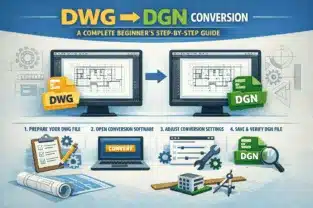
DWG to DGN Conversion

In today’s collaborative engineering and infrastructure projects, working with multiple CAD file formats is common. Two of the most widely used formats are DWG (AutoCAD) and DGN (MicroStation). When teams use different software platforms, accurate file conversion becomes essential. This is where DWG to DGN conversion plays a critical role.

This beginner-friendly guide explains everything you need to know about DWG to DGN conversion, including tools, processes, best practices, and common challenges.

What is DWG to DGN conversion?

DWG to DGN conversion is the process of transforming AutoCAD DWG files into MicroStation DGN format while maintaining design accuracy, layers, annotations, and geometry. DWG is primarily used in AutoCAD and other Autodesk tools, while DGN is the native format of Bentley MicroStation, widely used in infrastructure, transportation, and civil engineering projects.

Why DWG to DGN conversion is important

  • Cross-platform project collaboration
  • Government and infrastructure projects requiring DGN files
  • Maintaining design consistency across CAD software
  • Reducing rework and manual redrawing
  • Improving workflow efficiency

Common challenges

  • Loss of layers or incorrect layer mapping
  • Font and text alignment issues
  • Line style and weight mismatches
  • Missing blocks or symbols
  • Scaling and unit inconsistencies

Step-by-step guide

Step 1: Review the DWG file

Clean unnecessary layers, remove unused blocks and references, check drawing units and scale, and ensure text styles and fonts are standard.

Step 2: Choose the right conversion tool

Options include Bentley MicroStation, AutoCAD with export options, or dedicated CAD conversion software.

Step 3: Set conversion preferences

Map DWG layers to DGN levels, define line styles and weights, match colors and symbology, and set correct units and scale.

Step 4: Convert DWG to DGN

Import or open the DWG file in MicroStation, save or export in DGN format, and use batch conversion for multiple files if needed.

Step 5: Verify the converted DGN file

Check geometry accuracy, review text, dimensions and annotations, verify layers and line styles, and confirm scale and alignment.

Step 6: Final cleanup and optimisation

Fix text spacing issues, correct level naming, optimise file size, and apply MicroStation standards if required.

Best conversion tips

  • Always clean DWG files before conversion
  • Use standard fonts to avoid text errors
  • Maintain consistent units across files
  • Test convert a sample file before batch processing
  • Perform post-conversion quality checks

What is the difference between DWG and DGN files?

DWG and DGN are two distinct file formats used across the Australian engineering and construction industry. DWG, developed by Autodesk for AutoCAD, is the most widely used format in Australia and stores design data in a proprietary structure. DGN, used by Bentley’s MicroStation, is common in infrastructure and civil projects. The key differences lie in how they handle layers, symbology, and coordinate systems—DWG uses a flatter structure while DGN supports more complex cell-based elements, which can affect how our team converts between them for Australian projects.

Can DWG be converted to DGN without data loss?

Yes, with proper tools and settings, DWG to DGN conversion can be done with minimal or no data loss. Here at ASTCAD, we use specialised conversion software that preserves layer structures, line weights, and annotation data that comply with Australian standards. We recommend pre-conversion checks to ensure all custom blocks and references are compatible with MicroStation environments commonly used by Australian engineering firms. Our team can guide you through the process to maintain data integrity throughout the conversion.

Which software is best for DWG to DGN conversion?

Bentley MicroStation is one of the most reliable tools for accurate DWG to DGN conversion, and we recommend it as the industry standard for Australian engineering and infrastructure projects. We’ve successfully converted thousands of drawings for clients across Australia, and MicroStation consistently delivers high-fidelity conversions while preserving complex layer structures and annotation details. For best results, we suggest using MicroStation’s native conversion features rather than third-party tools, as this maintains compatibility with Australian standards and ensures your infrastructure designs remain precise throughout the conversion process.

Are DWG to DGN conversion tutorials helpful for beginners?

Yes, step-by-step tutorials help beginners understand settings, avoid errors, and ensure accurate results.

What are the most common DWG to DGN conversion errors?

The most common DWG to DGN conversion errors we see include incorrect layer mapping, font substitution issues, scale mismatches particularly with Australian standard drawing sizes, and line style differences between formats. We recommend validating your layer structures before conversion and ensuring all custom fonts are embedded or substituted with standard alternatives. Our team always advises checking scale settings against Australian engineering standards to prevent costly revisions on site.

Should I convert DWG to DGN manually or use professional services?

For simple drawings, manual conversion is sufficient. For complex or large projects, professional services are recommended.


CS

Claire Sutton

Architectural CAD Specialist & Technical Writer · BArch (Hons), QUT · ASTCAD, Brisbane

Claire has 10 years of experience in Revit BIM modelling, architectural documentation, and CAD conversion projects across Southeast Queensland and NSW. She has delivered NCC-compliant documentation for residential, commercial, and industrial facilities.

More articles by Claire Sutton →
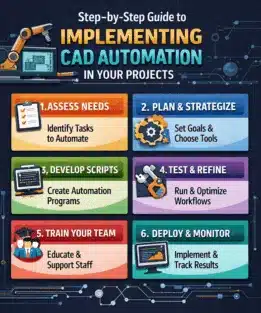
CAD AUTOMATION

In today’s fast-paced engineering and construction environment, efficiency and accuracy are no longer optional—they are essential. This is where CAD automation plays a critical role. By automating repetitive drafting and design tasks, organizations can significantly reduce errors, improve productivity, and ensure consistency across projects.

What is CAD automation?

CAD automation refers to the use of scripts, macros, rule-based systems, and software integrations to automate repetitive and time-consuming CAD tasks. By following structured CAD automation tutorials, teams can standardize workflows, reduce manual intervention, and achieve faster project turnaround times.

Benefits of CAD automation

  • Increased productivity by reducing repetitive manual tasks
  • Improved accuracy through standardized rules and templates
  • Faster project delivery with automated drafting workflows
  • Cost savings due to reduced rework and errors
  • Consistency across drawings regardless of project scale

Step 1: Identify repetitive tasks for automation

Common automation candidates include title block updates, layer creation and naming, dimensioning and annotation, block and symbol placement, file formatting and plotting, and BOM extraction.

Review completed projects and consult your CAD team to identify processes that consume excessive time. This step is critical in all CAD automation tutorials.

Step 2: Choose the right CAD automation tools

  • AutoLISP for AutoCAD
  • VBA and .NET APIs for advanced automation
  • Scripts and macros for repetitive commands
  • Parametric modeling tools
  • Third-party CAD automation plugins

Step 3: Standardize CAD templates and libraries

Automation works best when your drawings follow consistent standards. Standardize drawing templates, layer naming conventions, dimension styles, text styles, and block libraries before writing any scripts or macros.

Step 4: Develop simple automation scripts

Start small with scripts that automate basic tasks such as layer creation or title block updates. Examples: automatically generate layers based on project type, insert standard blocks with predefined attributes, or batch rename drawing files.

Step 5: Test automation on sample projects

Always test automation on sample files before deploying across live projects. Verify drawing accuracy, check compliance with standards, ensure compatibility with existing files, and confirm output consistency.

Step 6: Train your team

Training should include how to run scripts and macros, understanding automation limitations, basic troubleshooting, and best practices for automation use. Encouraging feedback from users will help refine your automation system over time.

Step 7: Integrate with other systems

  • CAD + ERP systems
  • CAD + BIM platforms
  • CAD + spreadsheet tools
  • CAD + document management systems

Step 8: Monitor, optimise, and scale

CAD automation is not a one-time task. Regularly monitor performance, improve scripts based on user feedback, expand automation to new workflows, and document all automation processes.

Implementing CAD automation is a smart investment for organizations looking to improve productivity, accuracy, and consistency. Contact ASTCAD to learn how our CAD automation services can streamline your drafting workflow.

What are CAD automation tutorials used for?

CAD automation tutorials help you streamline repetitive drafting tasks using scripts, macros, and built-in tools, which is essential for Australian firms managing large-scale projects across construction, engineering, and surveying sectors. Our tutorials guide you through automating common workflows like layer management, dimensioning, and compliance with Australian standards, ultimately reducing manual errors and freeing your team to focus on complex design work. We’ve found that implementing automation can significantly accelerate project timelines while maintaining the precision required for local council approvals and building code compliance.

Is CAD automation suitable for small projects?

Yes, CAD automation is beneficial for all project sizes, including small ones. We find that even basic automation routines can significantly reduce manual drafting time and minimise errors in your designs. For smaller Australian projects, you might start with simple tasks like standardising your line weights to comply with AS/NZS standards or automating common detail blocks. This approach lets you experience productivity gains without major workflow disruption, making it an ideal entry point before expanding automation across larger projects.

Do I need programming skills for CAD automation?

No, you don’t need programming skills to get started with CAD automation. We offer user-friendly tools and templates that allow Australian drafters and engineers to automate common tasks like layer management, title block updates, and repetitive drawing commands without any coding. For more advanced automation tailored to your specific workflows, our team can help you implement custom scripts, or you can develop basic automations using our intuitive interface. Most of our clients find that standard automation features save significant time on typical Australian building and construction projects right away.

What are the best CAD automation tips for beginners?

We recommend starting with simple repetitive tasks like generating standard title blocks or border sheets using our local Australian templates that comply with AS/NZS standards. Standardize your drawing conventions across your team first, then gradually introduce automation tools through our platform’s built-in features. Test all automated processes thoroughly in a controlled environment before rolling out to live projects, and invest time in training your team so they understand how to maintain and modify automation workflows. This staged approach helps Australian practices avoid disruptions while building confidence with CAD automation capabilities.

Can CAD automation reduce project costs?

Yes, CAD automation can significantly reduce your project costs. By minimizing design errors and rework, our automation solutions help Australian drafting teams work more efficiently, which directly lowers labour expenses and project timelines. We’ve helped many local engineering firms streamline their workflows, reduce manual drafting tasks, and deliver projects faster while maintaining quality standards. This means better margins for your business and faster turnaround for your clients.


JH

James Hartley

Senior Mechanical Engineer · BEng (Mechanical), UQ · Member, Engineers Australia · ASTCAD, Brisbane

James has 14 years of hands-on experience delivering CAD design, structural drafting, and engineering documentation across Australia’s mining, oil & gas, and manufacturing sectors. He specialises in SolidWorks, Autodesk Inventor, and AutoCAD for complex multi-discipline projects.

More articles by James Hartley →
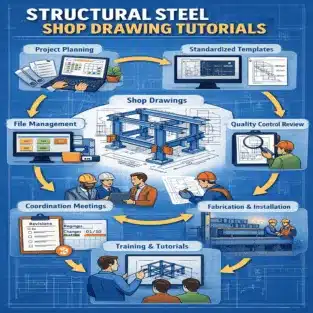
structural steel shop drawing

Structural steel shop drawings are essential in the construction and fabrication process. They serve as a bridge between design and construction, ensuring that structural components are accurately fabricated and installed. However, managing these projects efficiently can be challenging due to the complexity and volume of information involved. Proper organisation not only saves time but also reduces errors, improves communication, and ensures project deadlines are met.

In this guide, we explore practical tips for organising structural steel shop drawing projects efficiently, with a focus on best practices for beginners and professionals alike.

1. Understand the project scope before you start

Before starting a structural steel shop drawing project, review all architectural and structural plans, specifications, and client requirements. Understanding the type of steel components, connections, and materials involved helps you plan the drawing process more effectively and break complex structural plans into manageable segments.

2. Build a structured project plan with milestones

A well-structured project plan is the foundation of efficient organisation. Create a detailed timeline that includes milestones such as initial drafts, client reviews, and final approvals. Assign clear responsibilities to team members, especially on larger projects. Project management tools like Autodesk BIM 360, Procore, or even well-structured spreadsheets can track progress, deadlines, and revisions effectively. Create a checklist for each stage to ensure no step is missed.

3. Use standardised templates and CAD standards

Consistency is essential when dealing with multiple shop drawings. Using standardised templates for title blocks, scales, and symbols ensures clarity and reduces the likelihood of errors. Apply consistent CAD standards for line types, layer names, and dimension styles — this streamlines the workflow and facilitates smoother collaboration between designers, engineers, and fabricators.

4. Choose the right software

Popular software includes AutoCAD, Tekla Structures, Revit, and Advance Steel. These tools allow precise detailing, 3D modelling, and collaboration across teams. Ensure your chosen platform supports the file formats required by your fabricator and project stakeholders.

5. Implement rigorous file management and version control

Organise your CAD files with a clear folder structure, separating drawings by type, stage, or project segment. Use standardised file naming conventions with version indicators (e.g., Rev A, Rev B) to avoid confusion over revisions. Maintain a revision log detailing the version, date, changes made, and responsible team member. This ensures everyone is always working from the latest version.

6. Communicate early and often

Efficient structural steel shop drawing projects rely heavily on communication. Regular meetings, progress updates, and feedback sessions help identify issues early and prevent costly mistakes. Use cloud-based platforms to share drawings and comments in real time. Collaborate closely with fabricators — minor adjustments in drawings can often lead to significant cost savings and faster turnaround times.

7. Build in a thorough quality review process

Even with a well-organised system, errors can occur. Establish a multi-stage review process where drawings are checked for dimensional accuracy, compliance with project specifications, and consistency with related drawings before submission. Document all review comments and track their resolution systematically.

Key software tools for structural steel shop drawings

  • AutoCAD — widely used for 2D drafting and documentation
  • Tekla Structures — purpose-built for steel detailing with 3D modelling and fabrication output
  • Advance Steel — AutoCAD-based tool purpose-built for steel detailing
  • Revit — for BIM-coordinated structural documentation

Need professional structural steel shop drawings delivered to Australian Standards? Contact ASTCAD for a free, no-obligation quote. Our team delivers structural steel shop drawing services across Brisbane, Sydney, Melbourne, and Perth.


JH

James Hartley

Senior Mechanical Engineer · BEng (Mechanical), UQ · Member, Engineers Australia · ASTCAD, Brisbane

James has 14 years of hands-on experience delivering CAD design, structural drafting, and engineering documentation across Australia’s mining, oil & gas, and manufacturing sectors. He specialises in SolidWorks, Autodesk Inventor, and AutoCAD for complex multi-discipline projects.

More articles by James Hartley →
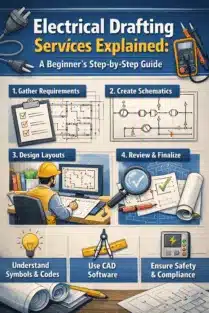
electrical drafting services

Electrical drafting is the production of technical drawings that document electrical systems — from simple single-line diagrams to complex panel layouts, schematic diagrams, wiring diagrams, and cable schedules. In Australia, electrical drawings must comply with AS/NZS 3000 (Wiring Rules) and applicable standards for the industry sector (AS/NZS 61439 for switchboards, AS 61511 for process safety systems, etc.).

Types of Electrical Drawings

Drawing TypeWhat It ShowsUsed By
Single-line diagram (SLD)Simplified overview of the electrical system — main switchboard, sub-boards, circuits, protection devicesElectricians, engineers, certifiers
Schematic diagramDetailed circuit operation — showing all connections between components using standard symbolsPanel builders, commissioning engineers
Wiring diagramPhysical layout of wiring — showing actual wire runs, terminal numbers, cable IDsElectrical contractors, maintenance
Panel layout drawingPhysical arrangement of components inside a switchboard or control panelPanel builders, fabricators
Cable scheduleTabular list of all cables — from/to, cable type, core count, length, conduit routeInstallers, project managers
Loop diagram / instrument loop diagramShows the connection of field instruments to control system I/OInstrumentation engineers, PLC programmers
Site layout / electrical services planFloor plan showing power outlet, lighting, cable tray, and conduit routing locationsElectrical contractors, builders
Protection relay settings sheetTabulated protection settings for each relay in the systemProtection engineers, network operators

Australian Standards for Electrical Drawings

  • AS/NZS 3000 — Wiring Rules: the foundational standard for all electrical installations in Australia. Electrical drawings for AS 3000 compliance show circuit protection, earthing, and switchboard layouts.
  • AS/NZS 1102 — Graphical symbols for electrical diagrams: defines the standard symbols used on Australian electrical drawings (switches, breakers, relays, motors, transformers).
  • AS 61439 — Switchgear and control gear assemblies: panel layout drawings and test documentation for switchboards must comply.
  • AS 60617 — Graphical symbols for diagrams: IEC-based symbols for schematic and wiring diagrams.
  • IEC 81346 — Reference designation system: structured naming and numbering of electrical components across drawings.

Electrical Drafting Software

SoftwareBest ForIndustry Use in AU
AutoCAD ElectricalFull electrical schematics, panel layouts, wire numbering, BOM generationVery High — manufacturing, mining, industrial
Eplan Electric P8Large-scale panel and MCC design, IEC standards-compliantHigh — process industries, OEM panel builders
SEE ElectricalMid-range schematic and panel designMedium — building services, smaller panels
Revit MEPBuilding electrical systems in BIM — power, lighting, dataHigh — commercial construction
AutoCAD (standard)Site plans, 2D electrical layoutsHigh — general electrical contracting
CADElec / ProfiCADBasic schematic draftingLow — small workshops

What Electrical Drawings Must Include (AS/NZS 3000)

Under AS/NZS 3000, electrical installations of a certain complexity must have drawings prepared before work begins. A compliant set of electrical drawings typically includes:

  • Single-line diagram showing incoming supply, main switchboard, all sub-boards, and circuit protection devices with ratings
  • Earthing and bonding diagram showing earth conductors, main earth bar, and protective earth connections
  • Circuit schedule listing every circuit: circuit number, description, cable size, protection device type and rating
  • Panel layout drawing for each switchboard showing component positions and cable entry points
  • For industrial installations: schematic diagrams for all control circuits, motor starters, and safety systems

Reading Electrical Drawings: Key Symbols and Conventions

Symbol / notationMeaning
— (horizontal line, single)Single-line representation of a three-phase circuit
MCB / MCCBMiniature / moulded case circuit breaker — with rating (e.g. 32A)
RCD / RCCBResidual current device — with sensitivity rating (e.g. 30mA)
RCBOCombined RCD + MCB
→ (motor symbol)Motor — with horsepower or kW rating and voltage
K1, K2Contactors — relay-operated switches for motor starters
E-StopEmergency stop — normally-closed pushbutton
PE / GNDProtective earth / ground connection
NNeutral conductor
L1, L2, L3Three-phase line conductors
Cable callout: 4C+E 2.5mm² Cu4-core + earth, 2.5mm² copper conductor cable

ASTCAD Electrical Drafting Services

ASTCAD’s electrical drafting team produces compliant electrical drawings for industrial, commercial, and infrastructure projects across Australia using AutoCAD Electrical, Eplan, and Revit MEP. Services include:

  • Single-line diagrams and schematic drawings
  • Panel layout and switchboard drawings
  • Wiring diagrams and cable schedules
  • Instrument loop diagrams
  • Site plans and electrical services plans
  • AS/NZS 3000 compliance documentation sets
  • Conversion of handwritten or legacy drawings to AutoCAD Electrical

Contact ASTCAD for a free quote on electrical drafting for your next project.


JH

James Hartley

Senior Mechanical Engineer · BEng (Mechanical), UQ · Member, Engineers Australia · ASTCAD, Brisbane

James has 14 years of experience delivering CAD design, structural drafting, and engineering documentation across Australia’s mining, oil & gas, and manufacturing sectors.

More articles by James Hartley →
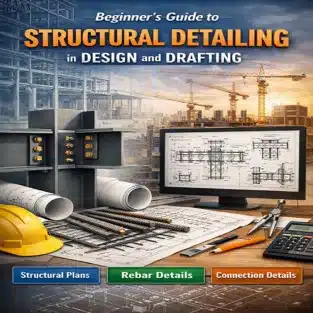
Structural Detailing

Structural detailing plays a vital role in transforming structural concepts into buildable, accurate, and safe construction documents. For beginners entering the field of structural engineering or CAD drafting, understanding the fundamentals of structural detailing is essential for producing high-quality drawings that meet industry standards. This Beginner’s Guide to Structural Detailing in Design and Drafting explains the core principles, workflows, and best practices that every novice should master.

What Is Structural Detailing in Design and Drafting?

Structural detailing is the process of preparing detailed drawings that show how structural elements such as beams, columns, slabs, footings, and reinforcements are to be constructed and assembled. These drawings act as a communication bridge between structural engineers, architects, contractors, and fabricators.

In structural design and drafting, detailing ensures that the engineer’s calculations are correctly represented on drawings, allowing structures to be built safely, efficiently, and without confusion on-site.


Importance of Structural Detailing for Beginners

For beginners, structural detailing is more than just drafting lines—it is about accuracy, coordination, and constructability. Poor detailing can lead to site errors, material wastage, delays, and safety risks.

Learning proper structural design and drafting tips early helps beginners:

  • Understand real-world construction practices
  • Improve drawing clarity and accuracy
  • Reduce rework and revisions
  • Build strong foundations for advanced structural projects

Key Structural Elements Every Beginner Should Know

Before starting structural detailing, beginners must be familiar with common structural components:

1. Foundations

Foundation drawings include footings, piles, pile caps, and raft foundations. Details must clearly show dimensions, reinforcement layouts, levels, and concrete grades.

2. Columns

Column detailing includes size, reinforcement bars, ties, lap lengths, and connection points with beams and slabs.

3. Beams

Beam details specify width, depth, reinforcement arrangement, stirrup spacing, and support conditions.

4. Slabs

Slab detailing shows thickness, reinforcement direction, spacing, openings, and edge conditions.

Understanding these components is essential in structural design and drafting tutorials for beginners.


Structural Design and Drafting Tips for Beginners

Here are some practical tips to help beginners create accurate and professional structural detailing drawings:

1. Start with Clear Design Intent

Always review architectural and structural design drawings before detailing. Understand load paths, structural systems, and material requirements.

2. Follow Drafting Standards

Use standard symbols, line types, fonts, and dimensioning styles as per local and international codes. Consistency improves readability.

3. Maintain Proper Scaling

Use appropriate scales for plans, sections, and details. Overcrowded drawings can confuse contractors.

4. Use Layers Effectively

Organize drawings using layers for beams, columns, reinforcement, dimensions, and annotations. This is a key structural design and drafting tip for managing complex drawings.

5. Add Clear Notes and Callouts

Well-written notes reduce ambiguity. Always specify material grades, bar diameters, spacing, and construction instructions.


Structural Design and Drafting Tutorials: Step-by-Step Workflow

Beginners can follow this basic workflow when learning structural detailing:

Step 1: Review Design Inputs
Study structural calculations, architectural plans, and design notes.

Step 2: Set Up the Drawing Template
Prepare CAD templates with proper units, scales, title blocks, and layers.

Step 3: Create Structural Layouts
Draft column grids, beam layouts, slab outlines, and foundation plans.

Step 4: Add Detailed Sections and Elevations
Include cross-sections, reinforcement details, and connection drawings.

Step 5: Perform Quality Checks
Check dimensions, reinforcement continuity, clash issues, and compliance with codes.

These structural design and drafting tutorials help beginners follow a systematic and error-free approach.


Common Mistakes Beginners Should Avoid

Many beginners struggle with similar detailing errors. Avoid these common mistakes:

  • Missing reinforcement details
  • Incorrect dimensions or scales
  • Overlapping text and symbols
  • Lack of coordination with architectural drawings
  • Ignoring construction feasibility

Learning from these mistakes improves drafting confidence and efficiency.


Tools Used for Structural Detailing

Beginners commonly use the following tools:

  • AutoCAD for 2D structural drafting
  • Revit Structure for BIM-based detailing
  • Excel for bar bending schedules
  • PDF markup tools for revisions

Mastering these tools supports long-term growth in structural design and drafting.


Benefits of Good Structural Detailing

Accurate structural detailing provides:

  • Smooth construction execution
  • Reduced site queries and RFIs
  • Improved safety and compliance
  • Cost and time savings
  • Better coordination among project teams

For beginners, developing strong detailing skills opens doors to professional drafting and engineering roles.


Final Thoughts

Structural detailing is a critical skill in the construction and engineering industry. For beginners, learning the fundamentals through structured practice, clear standards, and hands-on structural design and drafting tutorials can significantly improve drawing quality and career growth. By following proven structural design and drafting tips, beginners can confidently create accurate, buildable, and professional structural drawings.

What is the difference between structural design and structural detailing?

Structural design focuses on calculations and analysis to determine how a building will perform, while structural detailing converts those designs into clear, constructable drawings that builders can follow. We at ASTCAD understand that detailing requires knowledge of Australian Standards, construction methods, and site-specific requirements. Our experienced drafters ensure every dimension, material specification, and connection detail is precise and compliant with local building codes, making your project ready for construction.

Is structural detailing difficult for beginners?

It can be challenging initially, but with proper tutorials, practice, and drafting standards, beginners can master it effectively.

Which software is best for beginners in structural detailing?

At ASTCAD, we recommend AutoCAD for beginners starting their structural detailing journey, as it offers an intuitive interface and is widely used across Australian construction projects. For those interested in Building Information Modelling, Revit provides excellent capabilities for coordinating structural elements with other disciplines. We’ve found that many Australian engineers and drafters benefit from learning AutoCAD first to master fundamental detailing principles, then progressing to Revit for more complex, multi-disciplinary projects. Both software options align well with Australian building codes and standards.

Why are structural detailing drawings important?

Structural detailing drawings are crucial because they ensure accurate construction, reduce costly errors, and help contractors clearly understand reinforcement placement and assembly requirements. At ASTCAD, we create detailed drawings that comply with Australian Standards and building codes, providing contractors with the precise specifications needed for safe and efficient on-site execution. Our comprehensive details save time and money by preventing misinterpretation and rework during construction.

How long does it take to learn structural detailing?

With consistent practice, beginners can learn basic structural detailing within 3–6 months. At ASTCAD, we recommend starting with Australian Standards like AS 3600 for concrete and AS 4100 for steel, which form the foundation of our local drafting practices. Our experience shows that mastering these standards alongside CAD software typically takes 6–12 months for proficiency. The timeline varies depending on your prior experience with design software and engineering concepts, but we’re here to guide you through every stage of your learning journey.

What are the essential skills needed for structural drafting?

Understanding construction methods, drafting standards, CAD tools, and structural fundamentals are key skills.


JH

James Hartley

Senior Mechanical Engineer · BEng (Mechanical), UQ · Member, Engineers Australia · ASTCAD, Brisbane

James has 14 years of hands-on experience delivering CAD design, structural drafting, and engineering documentation across Australia’s mining, oil & gas, and manufacturing sectors. He specialises in SolidWorks, Autodesk Inventor, and AutoCAD for complex multi-discipline projects.

More articles by James Hartley →

Need expert structural design services in Australia? ASTCAD’s structural design team delivers compliant engineering drawings and documentation for residential, commercial and industrial projects across Brisbane, Sydney, Melbourne and Perth. Request a free quote today.

Get a free quote — 1800 287 223