
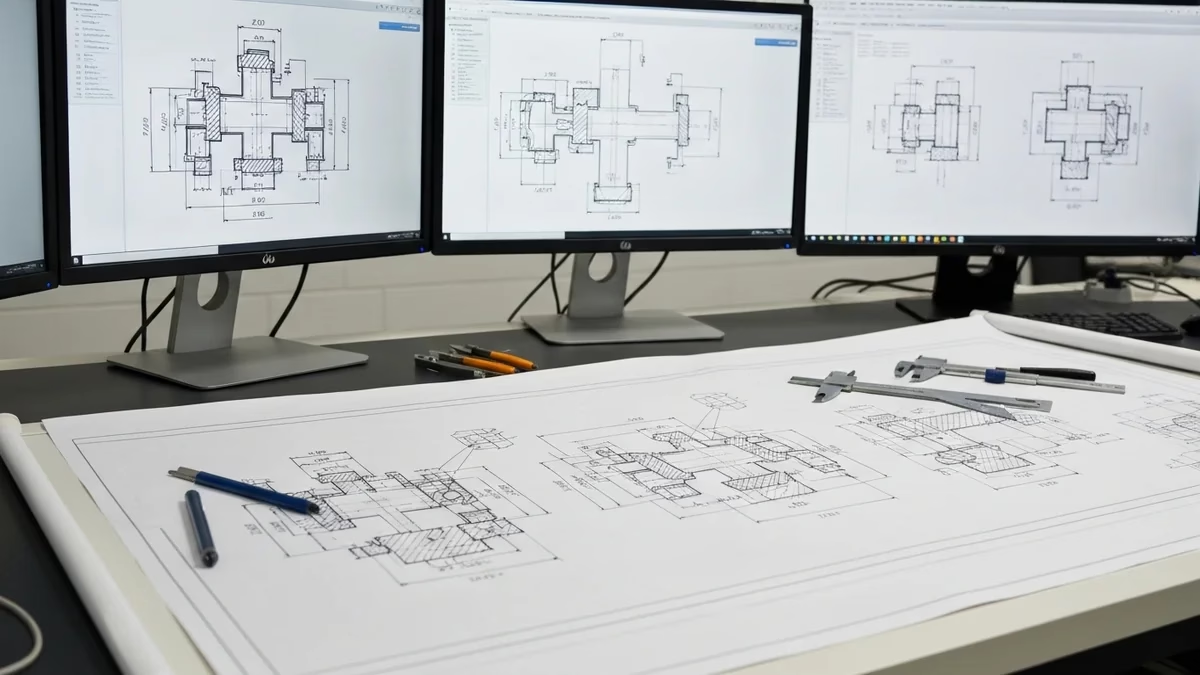
CAD drafting — short for Computer-Aided Design drafting — is the process of creating precise, detailed technical drawings using specialised software. It is the universal language of engineering and construction in Australia, replacing hand drafting from the 1980s onwards and becoming the foundation of every project from residential renovations through to major infrastructure. Whether you’re an engineer, project manager, architect, or builder, understanding what CAD drafting is and how it works helps you communicate more effectively with your drafting team and make better decisions for your project.
This guide covers the definition of CAD drafting, the different types, the software used, the key disciplines it covers in Australia, and why businesses choose to outsource it. If you’re looking for professional CAD drafting services across Brisbane, Sydney, Melbourne, Perth, or Gold Coast — or you’re simply trying to understand what your drafting provider actually does — you’re in the right place.
CAD drafting is the use of computer software to produce technical drawings — the precise, dimensioned, and standards-compliant documents that engineers, fabricators, builders, and councils use to construct or approve projects. It replaced traditional hand drafting (pencil on paper over a tilted drawing board) and is now the universal standard across all engineering and construction disciplines globally.
At its core, CAD drafting captures two things: geometry — the exact shape and dimensions of objects — and annotation — the notes, symbols, tolerances, and specifications that tell someone how to build it. A CAD drawing is not simply a picture. It is a precise technical document with legal and contractual significance, used to obtain council approvals, guide fabricators, and direct tradespeople on site.
In Australia, CAD drafting is governed by standards including AS1100 (Technical Drawing Standards) and the National Construction Code (NCC), which specify how drawings must be formatted, dimensioned, and labelled to be legally compliant and usable by contractors and councils.
Before CAD software, draftspeople worked at tilted drawing boards using pencils, rulers, set squares, and technical pens. Every line was drawn by hand, every revision required erasing and redrawing, and producing a full set of construction drawings could take weeks of skilled labour.
CAD software transformed this process completely. The key advantages over manual drafting are:
- Speed: drawings that took days by hand can be completed in hours using CAD software.
- Accuracy: dimensions are mathematically precise — there is no human measuring error in line placement or scaling.
- Revisions: changing a design means editing the digital file, not starting over. Revisions that once took days now take minutes.
- Reusability: components, drawing blocks, and standard details can be saved in libraries and reused across projects.
- Collaboration: CAD files can be shared instantly with engineers, fabricators, builders, and councils anywhere in Australia or the world.
- 3D capability: modern CAD software generates three-dimensional models that can be visualised, rotated, analysed, and simulated before a single piece of material is ordered.
CAD drafting encompasses a broad range of drawing types, outputs, and methodologies. Understanding the main categories helps you communicate clearly with your drafting provider and ensure you’re commissioning the right type of work for your project.
2D CAD drafting produces flat, plan-view drawings — floor plans, elevations, sections, construction details, schematics, and fabrication drawings. This is the most commonly requested output in construction and engineering. AutoCAD is the industry standard for 2D drafting and is used across mechanical, structural, electrical, architectural, and civil disciplines throughout Australia. 2D drawings are submitted for council approval, used on construction sites, and issued to fabricators for manufacturing.
3D CAD modelling creates three-dimensional digital representations of parts, assemblies, structures, or buildings. Software like SolidWorks, Inventor, and Fusion 360 are used for mechanical and product design, while Revit is used for architectural and structural 3D modelling. 3D models allow engineers to visualise designs before construction, run stress analyses and simulations, generate accurate material quantities, detect design clashes before they become costly site problems, and produce photorealistic renders for client approval.
BIM is an advanced form of 3D modelling that embeds data into the model — not just geometry, but specifications, costs, schedules, and performance data. A BIM model of a building contains information about every structural member, every pipe, every door — allowing project teams to coordinate design across all disciplines, detect clashes between structure, services, and architecture, and manage the asset through its entire lifecycle. Revit is the dominant BIM platform in Australia, and BIM is increasingly mandated on government infrastructure and commercial projects.
Schematic drafting is used in electrical engineering to produce single line diagrams, panel layouts, P&IDs (Piping and Instrumentation Diagrams), and wiring diagrams. Software like AutoCAD Electrical and EPLAN are used for these specialised outputs. Unlike plan drawings, schematics are not drawn to scale — they show logical connections and system relationships rather than physical geometry and placement.
CAD drafting is used across every engineering discipline in Australia. Each has its own standards, preferred software, and drawing conventions that drafters must understand deeply to produce compliant, usable documentation.
Mechanical CAD drafting covers machine components, assemblies, manufacturing drawings, fabrication details, sheet metal design, and product development. It requires deep knowledge of tolerancing (GD&T), material properties, and manufacturing processes. Software used includes AutoCAD, SolidWorks, and Inventor. ASTCAD’s mechanical drafting services serve mining, aerospace, marine, automotive, and industrial manufacturing clients across Australia.
Structural CAD drafting produces drawings for steel, concrete, and timber structures — including structural steel shop drawings, reinforcement drawings, connection details, and AS/NZS-compliant structural documentation. Structural drafting works alongside structural engineers and must comply with Australian standards including AS4100 (steel structures) and AS3600 (concrete structures). Explore our structural drafting services for more detail on what’s involved.
Electrical CAD drafting covers schematics, panel drawings, single line diagrams, wiring diagrams, and electrical layouts for commercial, industrial, and residential projects. Australian electrical drawings must comply with AS/NZS 3000 (the Wiring Rules) and relevant industry codes. Our electrical drafting team works with electricians, electrical engineers, and OEM manufacturers across Brisbane, Sydney, Melbourne, and Perth.
Architectural CAD drafting produces floor plans, elevations, sections, 3D renders, development application (DA) drawings, and construction documentation for residential, commercial, and industrial buildings. In Australia, architectural drawings submitted for council approval must meet specific formatting and content requirements under the NCC and each council’s local planning scheme. Accuracy and compliance at DA stage can save months of back-and-forth with local authorities.
Civil CAD drafting covers roads, drainage, stormwater, sewerage, earthworks, and site development drawings. Civil drafters typically use AutoCAD Civil 3D and must produce documentation compliant with local council infrastructure standards and the AGRD (Australian Guide to Road Design). Our civil drafting services support land developers, civil engineers, and local governments across Australia.
The software used depends on the discipline and type of output required. Here are the most commonly used CAD platforms in Australian engineering and construction in 2026:
- AutoCAD: the universal industry standard for 2D drafting across all disciplines — used by the vast majority of Australian drafters.
- Revit: the dominant BIM platform for architectural, structural, and MEP (mechanical, electrical, plumbing) design in Australia.
- SolidWorks: the leading software for mechanical product design, assemblies, and manufacturing drawings.
- Inventor: Autodesk’s mechanical CAD and product simulation platform, widely used in Australian manufacturing and industrial design.
- Civil 3D: Autodesk’s civil engineering platform for road design, drainage, earthworks, and land development.
- MicroStation / OpenRoads: used primarily on major infrastructure and government projects in Australia, particularly for transport and utilities.
- Navisworks: used for BIM model coordination, multi-discipline clash detection, and 4D construction simulation.
Many engineering firms, builders, and manufacturers outsource their CAD drafting to specialist companies rather than employing full-time in-house drafters. The reasons are straightforward:
- Cost efficiency: outsourcing avoids the full cost of employment — superannuation, leave entitlements, equipment, ongoing training, and office space are all transferred to the provider.
- Scalability: project workloads fluctuate. Outsourcing lets you scale drafting resources up or down without the complexity and cost of hiring or making staff redundant.
- Access to specialists: a full-service CAD company has mechanical, structural, electrical, architectural, and civil drafters — giving you access to every discipline without maintaining separate specialist employees.
- Turnaround speed: established CAD companies have proven workflows, drawing templates, and block libraries that allow faster delivery than building that capability in-house from scratch.
- Software and licensing: professional CAD software licences are expensive and require ongoing maintenance. Outsourcing transfers that cost and responsibility to the provider.
CAD drafting is used to produce technical drawings for engineering, construction, and manufacturing projects. Common applications include architectural floor plans and council documentation, structural steel shop drawings, mechanical fabrication drawings, electrical schematics and panel layouts, civil engineering road and drainage plans, product design drawings for manufacturing, and 3D models for simulation, rendering, and 3D printing.
Drafting is the broader discipline of producing technical drawings — it existed long before computers, using pencil and paper on a drawing board. CAD (Computer-Aided Design) is the computer-based method of performing that same work. In modern professional practice in Australia, CAD drafting and drafting are effectively synonymous — virtually all technical drawing is now done using CAD software rather than by hand.
Engineers design — they determine what needs to be built, perform calculations, and take professional responsibility for the design. CAD drafters document — they translate the engineer’s design intent into precise, construction-ready drawings. Most projects need both. Many CAD companies (including ASTCAD) employ licensed engineers on staff who can provide both engineering design and drafting services under one roof, simplifying the project management process significantly.
CAD drawings are mathematically precise — dimensions in a CAD file are exact to whatever unit of measurement is used. Accuracy in a delivered drawing depends on the quality of the input information and the skill of the drafter. A CAD drafter working from a good brief, accurate survey data, and clear engineering input will produce drawings accurate to fractions of a millimetre. This precision is one of the primary advantages of CAD over manual drafting, which introduced human measurement error at every step.
The most common CAD file formats in Australia are DWG (AutoCAD’s native format and the universal industry standard), DXF (Drawing Exchange Format for cross-software compatibility), PDF (for distribution, review, and council submission), RVT (Revit’s native BIM format), and SLDPRT/SLDASM (SolidWorks part and assembly files). Always confirm what format your fabricator, contractor, or engineer requires before work commences — most CAD companies can deliver in multiple formats at no extra cost.
Look for a company with licensed engineers overseeing the work, demonstrated experience in your specific discipline, a clear familiarity with Australian Standards, and a transparent quoting and revision process. Ask to see samples of comparable work, confirm their software matches your project requirements, and check whether they have a local Australian presence — particularly important for projects requiring site visits, council liaison, or direct collaboration with your engineering team.
ASTCAD is a Brisbane-based CAD design and drafting company serving engineering firms, builders, manufacturers, and architects across Australia. With expertise across mechanical, structural, electrical, architectural, and civil disciplines, our team delivers accurate, standards-compliant drawings with a 24-hour quote turnaround. Get your free quote today.
What is CAD drafting used for?
CAD drafting is used to produce precise technical drawings for engineering, construction, and manufacturing projects across Australia. We create architectural floor plans, structural shop drawings, mechanical fabrication drawings, electrical schematics, and civil engineering plans that meet Australian Standards and building codes. Our CAD services help engineers, architects, and contractors visualize projects, streamline construction processes, and ensure compliance with local regulations before work begins on site.
What is the difference between CAD and drafting?
Drafting is the discipline of creating technical drawings that communicate design intent, while CAD is the computer technology that enables this work. In Australia’s engineering and construction sectors, these terms are now virtually interchangeable since almost all professional drafting relies on CAD software like AutoCAD or Revit. We use CAD tools to produce drawings that comply with Australian Standards and support building approvals, ensuring precision and efficiency that manual drafting simply cannot match.
Do I need a CAD drafter or an engineer?
Engineers design and take professional responsibility for the design, while CAD drafters translate that vision into precise, construction-ready drawings. Most Australian projects require both roles working together. We recommend consulting an engineer for complex structural or compliance work, then having a CAD drafter prepare detailed drawings for builders and council submissions. ASTCAD has licensed engineers on staff who can provide both services, ensuring your project meets Australian building codes and standards from concept through construction documentation.